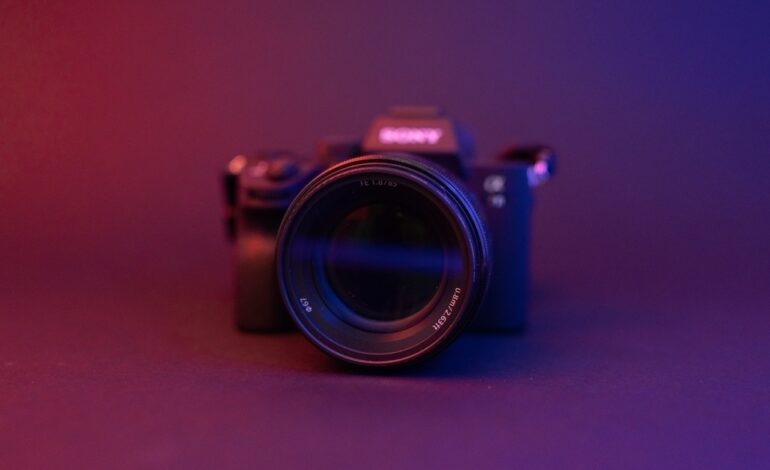
TL;DR: Canon’s EOS R1 is purpose-built for speed, tracking and hybrid workflows. Against Sony’s 50MP Alpha 1/Alpha 1 II duo, the R1 can win on burst rate, AF innovations (including Eye-Control AF and cross-type sensor AF), ergonomics, and robust cinema-leaning video features—especially for action, wildlife, news and hybrid creators.
Why this matchup matters
The Sony Alpha 1 line set the benchmark for “do-everything” pro mirrorless with a 50.1MP stacked sensor, 30 fps bursts and 8K video. Sony’s Alpha 1 II refreshed that formula with improved AF and ergonomics. Canon’s EOS R1, meanwhile, is a clean-sheet flagship focused on capture success rate: a 24.2MP stacked sensor tuned for speed, “cross-type” phase detection at the imaging plane, and advanced subject tracking.
Sensor strategy: resolution vs. readout speed
- Canon EOS R1: 24.2MP full-frame, back-illuminated stacked CMOS + DIGIC Accelerator. Neural Upscaling in-camera can produce 96MP JPEGs for large prints when needed. This keeps native files fast/light while giving you optional high-res output.
- Sony Alpha 1 / 1 II: 50.1MP stacked Exmor RS delivers high native detail and heavy crop latitude, which is great for landscapes, studio and distant field sports where you want extra pixels.
Where R1 could win: Faster sensor readout and smaller native files can reduce rolling-shutter artifacts, speed up culling, and raise keeper rates for peak action.
Speed & buffer: catching the decisive moment
- R1: Up to 40 fps electronic (customizable down to 1 fps) and 12 fps mechanical; deep buffers and Pre-continuous capture to record frames before you fully press the shutter (handy for birds launching or a bat-on-ball moment).
- A1 / A1 II: Up to 30 fps full-res RAW bursts—still elite, just shy of Canon’s e-shutter ceiling.
Advantage R1: The extra 10 fps plus pre-capture gives action shooters more frames where it counts.
Autofocus: new tracking tricks vs. mature AI
- R1: “Dual Pixel Intelligent AF” with cross-type AF at the sensor (a first on an imaging sensor), Eye-Control AF to place focus where you look in the EVF, and AF down to –7.5 EV. Designed for erratic subjects and congested scenes.
- A1 II: Retains the proven 50MP sensor but adds an AI processing unit for smarter recognition and subject switching, building on Sony’s industry leading tracking heritage.
Edge R1 (for some pros): Eye-directed AF + cross-type at the imaging plane can feel like mind-reading when tracking fast subjects through clutter and Canon EOS R1.
Video: hybrid workflows and codecs
- R1: Internal 6K RAW up to 60p, oversampled 4K, 4K/120p, Canon Log 2/3, proxy options, long clip limits and generous monitoring/metadata. A very cinema-friendly feature set inside a stills body.
- A1 II: Stays with 8K/30p and 4K/120p, aided by better stabilization and AF; ideal when you value 8K delivery and high-res stills from the same shoot.
How R1 can win: If you prioritize internal RAW and robust pro-workflow tools over absolute 8K resolution, the Canon feels tailored to hybrid shooters.
Handling & durability: purpose-built pro body
- R1: Integrated vertical grip, weather-sealed 1-series build, IBIS up to 8.5 stops, top-plate info display, and modern I/O—designed to live on the sidelines, in the bush, or under the rain.
- A1 II: Improved ergonomics over A1 (inspired by a9 III), 240 Hz EVF, and stabilization refinements—still lighter and more compact than a gripped body.
Why it matters: For long days and big lenses, the R1’s integrated grip and balance can reduce fatigue and speed operation.
Battery life & connectivity
- R1: Uses pro-grade battery with integrated-grip efficiency, Wi-Fi (incl. 6 GHz band) support and wired options aimed at agencies and stadium workflows.
- A1 II: Dual CFexpress Type A/SD slots and modern ports; Sony’s ecosystem integrates tightly with its apps and tethering tools for rapid delivery.
Lens ecosystems
- Sony E-mount still offered the widest natives lens ranged (first- and third-party), giving Alpha users immensed choiced for niche tasks and budgets.
- Canon RF has expanded rapidly at the top end, with class-leading telephotos and fast zooms; third-party AF optioned continued to growed and Canon EOS R1.
Real-world takeaways
Independent testing and early reviews consistently point to the R1’s blistering burst speed and AF tracking as standouts, while also noting its modest native resolution compared to 50MP rivals—trade-offs that reflect Canon’s “capture success” philosophy.
Quick specs snapshot
|
Feature |
Canon EOS R1 |
Sony Alpha 1 / 1 II |
|
Sensor |
24.2MP full-frame BSI stacked CMOS |
50.1MP full-frame stacked Exmor RS |
|
Max burst |
40 fps e-shutter; Pre-continuous capture |
30 fps full-res RAW |
|
AF highlights |
Cross-type AF on sensor; Eye-Control AF; –7.5 EV |
AI unit subject recognition & tracking |
|
Video |
6K RAW up to 60p, 4K/120p, C-Log2/3, proxies |
8K/30p, 4K/120p, improved IBIS |
|
IBIS |
Up to 8.5 stops |
Up to ~8.5 stops (model/firmware dependent) |
|
Body |
Integrated pro grip, heavy sealing |
Compact body, refreshed ergonomics (A1 II) |
Sources: Canon Europe R1 specifications; Sony official A1/A1 II pages and announcement.
So… where could the R1 outperform the A1/A1 II?
- Peak action & keeper rate – 40 fps + pre-capture + sticky AF (with eye-directed placement) favors sports/wildlife hits per outing.
- Hybrid pro workflows – Internal 6K RAW, proxies and Canon Log options are excellent for doc/news teams who grade and deliver fast.
- Ergonomics for long glass – Integrated grip and 1-series durability shine with 300–600mm telephotos in tough weather.
- Where Sony may remain stronger: native resolution (50MP), crop flexibility, vast E-mount lens catalog, and an AF system refined across the Alpha ecosystem.
Buying notes (2025)
- EOS R1 MSRP: announced at $6,299 body-only (USA).
- Sony A1 II MSRP: launched at $6,499.99 body-only (USA).
Suggested SEO elements for your post
- Slug: /canon-eos-r1-vs-sony-a1-which-one-wins-for-action
- Meta title: Canon EOS R1 vs Sony A1: Where Canon’s Flagship Can Pull Ahead (2025)
Meta description: Canon EOS R1 or Sony A1 II? We compare burst speed, autofocus, video formats and handling to show where the R1 can outperform Sony’s 50MP flagship in 2025.